Nepal Rastra Bank bank has introduced strict new disclosure rules for senior executives and significant shareholders across the country's banking sector. The Nepal Rastra Bank (NRB) has amended its Unified Directives, 2082, requiring commercial banks and financial institutions to conduct rigorous background checks on top-tier staff and high-value investors. These newly enforced regulations apply broadly to all Class A, B, and C financial institutions operating within the country.
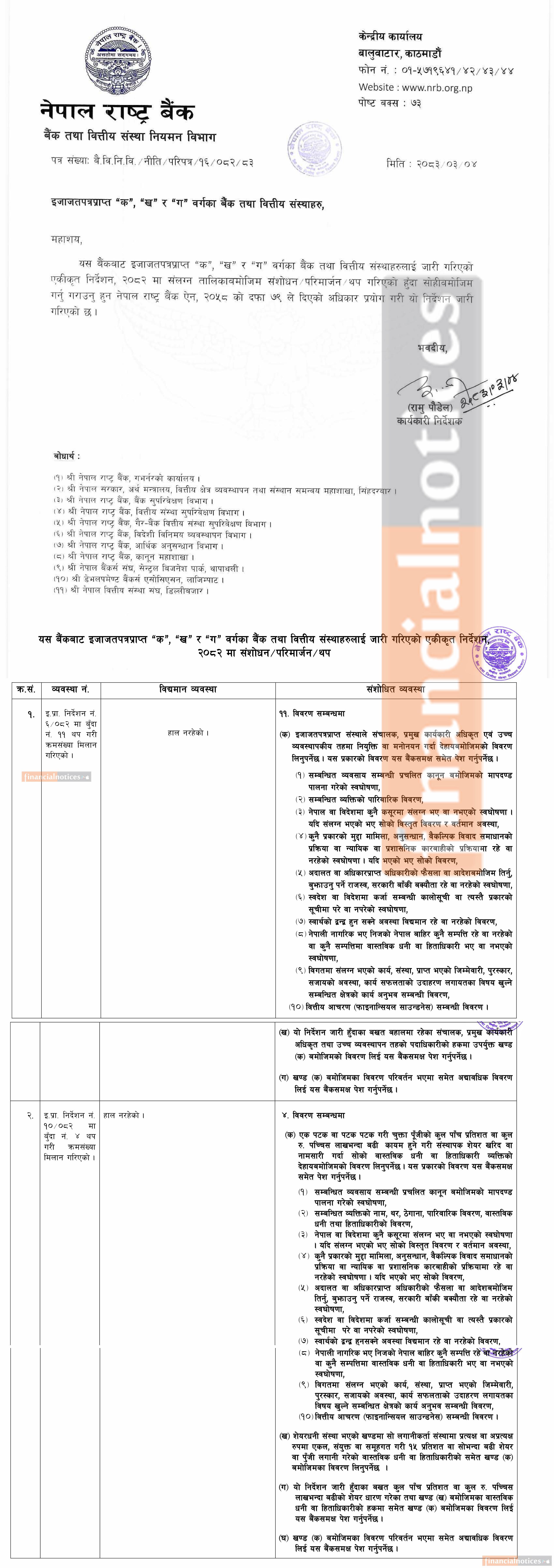
Under the new measures, individuals appointed as board directors, chief executives, and senior managers are now legally obligated to submit comprehensive personal and financial declarations directly to the central bank.
These mandated disclosures include self-declarations regarding any involvement in criminal offences, ongoing legal disputes, or administrative investigations both domestically and internationally. Furthermore, officials must provide clear confirmation regarding any outstanding government tax liabilities, state whether they have ever been blacklisted for credit defaults, and disclose potential conflicts of interest alongside their detailed professional experience and family backgrounds.
Notably, Nepalese citizens in these top positions are now required to explicitly disclose any properties held abroad or clarify if they act as the ultimate beneficial owners of foreign assets. The NRB has stated that these rules apply retroactively, meaning all currently serving directors and senior officials must submit these details to the regulator immediately and continuously update them if their circumstances change.
In addition to executive vetting, the central bank has moved to significantly increase transparency regarding institutional ownership by introducing a strict threshold to identify the ultimate beneficial owners of promoter shares. Detailed financial and regulatory disclosures are now mandatory whenever an individual or entity acquires or transfers promoter shares amounting to 5% or more of a bank's total paid-up capital, or exceeding 2.5 million Nepalese rupees (NPR 25 Lakhs). If the shares are purchased by an institutional investor, any individual holding a stake of 15% or more singly or jointly in that purchasing company must also declare their identity and complete financial background to the central bank.
These high-value shareholders are subject to the exact same scrutiny regarding criminal records, tax liabilities, and foreign assets as bank executives. As with the executive rules, existing shareholders who already meet these financial thresholds are required to comply immediately with the new reporting standards.
Published by Nepal Rastra Bank on 2083-3-4
View More by Nepal Rastra Bank